



18 Beach Ave. Mordialloc,
Victoria 3195. Australia
Tel: +61 3 95871385; Fax: +61 3 95871467
Email: info@gastechengine.com.au

- Combustion efficiency rather than exhaust catalytic aftertreatment is the primary means to control tailpipe emissions. Approximately 40% excess air is supplied to the combustion chamber in the lean-burn system. Unburned hydrocarbons (HC) and carbon monoxide (CO) are oxidised. Abundant oxygen is available for combustion. The additional air also reduces peak combustion temperatures lowering the formation rate of oxides of nitrogen (NOx).
- Simultaneous reduction of HC and NOx while maintaining high efficiency with good knock margin requires careful development of the entire combustion system. Optimization of compression ratio, turbo boost control, air/fuel ratio, ignition timing, and combustion chamber shape are critical to successful operation of the engine. Fine tuning for good starting.
- Oil consumption control is also critical since unburned lube oil contributes to exhaust particulate emissions. Most diesel engines are not designed to reduce oil consumption under intake vacuum conditions. This occurs with throttled engines during idle and deceleration. Redesign of the piston ring pack and the addition ofsuitable intake valve seals are normally required.
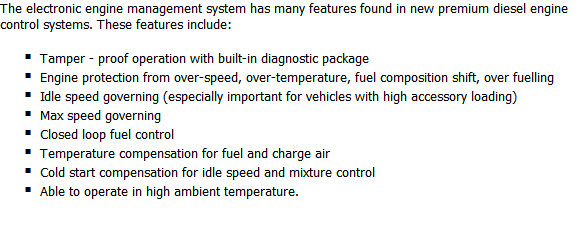
- The cylinder heads are machined for spark plug installation. Premium exhaust valves and seat materials are used for long life under gaseous - fuelled operation. Valve covers are modified as necessary for spark plug and ignition wire installation. We offer both fullyl electronic and manual fuel and ignition systems depending on customer requests, engine type and application.

Emissions in a controlled engine environment are managed by the design of the engine map. According to the desired levels of resultant emissions, the precise level of emissions is set to be achieved in an operational environment. By way of example the following are achieved in current markets.
Emissions

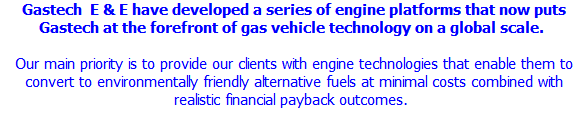
Gastech E & E have developed HDV gas engine technologies that can operate on either compressed natural gas (CNG) or liquefied natural gas (LNG).
We term this technology "Diesel Ignition Technology" which is a dual fuel multi port electronic sequential injection technology that operates on a small amount of diesel for combustion ignition followed by natural gas in the form of either CNG or LNG.
Gastech are achieving diesel substitution rates with their natural gas technologies in the ranges of 80% to 95% on their engine dynamometer facility and road testing programs.
Some Of The Main Advantages Of This Technology Are:
- Can operate in dual fuel mode with same power and torque charastistics displayed by the diesel-powered engine.
- No de-rating of engine horsepower in gas mode.
- Seamless change back to 100% diesel without the loss of power or torque.
- Capable of converting most diesel capacity engine ranges.
- Full ECU control by Gastech's engine management system.
Other Diesel Engine Technologies:
For the smaller diesel engine ranges, Gastech has developed dedicated multiport fuelling technologies with lean-burn, spark-ignition combustion (100% gas) kits.
Our lean-burn technology offers power and torque equal to the base diesel engine with the added advantage of low emissions, acceptable combustion temperatures and high efficiency.
Automotive Fuel Technology:
Gastech E & E can convert petrol engines to operate on "bi-fuels" or dedicated gas operation (LPG, CNG) using our multi port electronically controlled fuel injection with no loss of power or engine efficiency.

Heavy-Duty Vehicle (HDV) Engine Technologies


Copyright © 2006 - present .Gastech Engine & Equipment Pty Ltd. ABN 54098397285. All rights reserved